# Psychrometric Chart

**Clima** allows the user to visualize all annual weather conditions on a [psychrometric diagram.](https://cbe-berkeley.gitbook.io/clima/documentation/tabs-explained/psychrometric-chart/psychrometric-chart-explained)

The default diagram allows the users to overlay the frequency with which weather conditions recur throughout the year.

<figure><img src="https://491114279-files.gitbook.io/~/files/v0/b/gitbook-x-prod.appspot.com/o/spaces%2F-MhupA7DXRC4lRDTpJQJ%2Fuploads%2Fgit-blob-34998544aecff2f409e5ff013548cf39a7276451%2FCBEClima_New.York-Downtown.Manhattan.Heli_USA_psy_tab%20(1).svg?alt=media&#x26;token=2a7788c7-3a7b-481c-bd1f-ac151b3ef686" alt=""><figcaption><p>Example: Frequency of climatic condition in the Psychrometric chart of <strong>New York, USA</strong></p></figcaption></figure>

With the first choice in the drop-down list, "None", it is possible to view temperature conditions in the psychrometric diagram over the entire year. The visualized dots have the same gradient with a transparency rate, they are not colored according to a legend. Multiplying them when overlaid provides a visualization of their frequency, so the most common conditions.

<figure><img src="https://491114279-files.gitbook.io/~/files/v0/b/gitbook-x-prod.appspot.com/o/spaces%2F-MhupA7DXRC4lRDTpJQJ%2Fuploads%2Fgit-blob-c6ad36d4cde9cadd948db245cdd1b1d9d2d145f4%2FCBEClima_New.York-Downtown.Manhattan.Heli_USA_psy_tab.svg?alt=media&#x26;token=6eb5794d-b7bb-4627-be8a-2d0f34ab28c4" alt=""><figcaption><p>Example: Psychrometric chart with climatic conditions of <strong>New York, USA</strong></p></figcaption></figure>

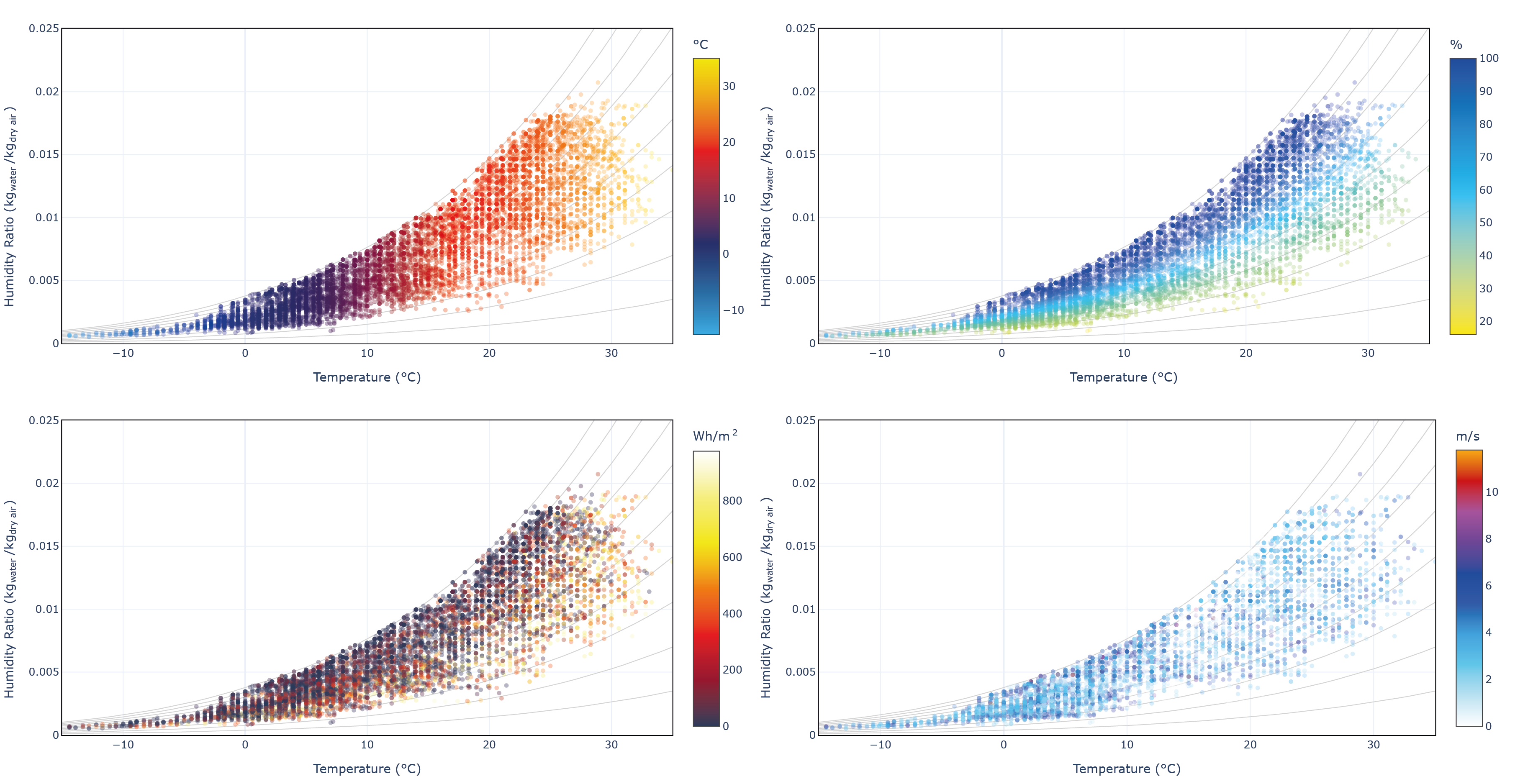
Then, users can overlay another variable on the graphs, choosing from [Clima dataframe](https://cbe-berkeley.gitbook.io/clima/documentation/tabs-explained/tab-summary/clima-dataframe).

<figure><img src="https://491114279-files.gitbook.io/~/files/v0/b/gitbook-x-prod.appspot.com/o/spaces%2F-MhupA7DXRC4lRDTpJQJ%2Fuploads%2Fgit-blob-6e1e81a998118e07981db481639ad7667bcde05e%2FPsychometric%20variables.png?alt=media" alt=""><figcaption><p>Example: Psychrometric charts with different variables (from top left to bottom right): dry bulb temperature, relative humidity, global horizontal radiation, and wind speed</p></figcaption></figure>

Moreover, data can be filtered by date, time, or one of the [Clima dataframe](https://cbe-berkeley.gitbook.io/clima/documentation/tabs-explained/tab-summary/clima-dataframe) variables.

<figure><img src="https://491114279-files.gitbook.io/~/files/v0/b/gitbook-x-prod.appspot.com/o/spaces%2F-MhupA7DXRC4lRDTpJQJ%2Fuploads%2Fgit-blob-8ac37c64069a231a5342e411b6522b81bd447432%2FSchermata%202022-11-15%20alle%2010.37.43%20AM.png?alt=media" alt=""><figcaption><p>Psychrometric charts filters</p></figcaption></figure>

### Video Tutorial

Learn more about the Psychrometric tab by watching the following video.

{% embed url="<https://youtu.be/VJ_wOHadVdw?si=iAcBQpq3IgCNY-H6&t=582>" %}