# Outdoor Comfort

The **Outdoor Comfort** tab shows an overview of the perceived environmental condition based on the UTCI model.

The [Universal Thermal Climate Index](http://www.utci.org/index.php) (UTCI), introduced in 1994, aims to be the measure of human physiological reaction to the atmospheric environment.

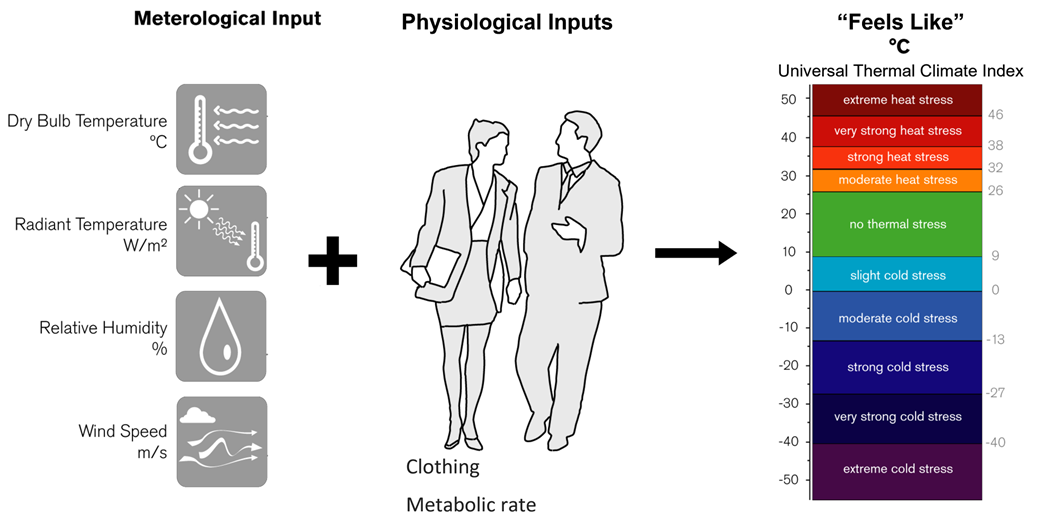
<figure><img src="/files/y4FKVaqQW5aBYdtiTIEl" alt=""><figcaption><p>Graphical scheme of the UTCI calculation methodology</p></figcaption></figure>

It considers:

* dry bulb temperature
* mean radiant temperature
* wind speed
* relative humidity

to calculate a reference environmental temperature causing strain when compared to an individual's response to the real environment. It is based on [Fiala et al](https://link.springer.com/article/10.1007/s00484-011-0424-7).'s multi-node model of thermo-regulation.

The [UTCI equivalent temperature](https://doi.org/10.1016/j.wace.2018.01.004) is a function of the above parameters, which are combined in a multinode thermo-physiological model that takes into account clothing insulation and metabolic rate. From this a[Universal Thermal Climate Index](http://www.utci.org/index.php) (UTCI) of perceived thermal stress is derived.

**Clima** allows the user to visualize the annual UTCI equivalent temperature as heatmap under various environmental conditions.

<figure><img src="/files/mUUdNcpDG43lLB0rl0CH" alt=""><figcaption><p>Example: UTCI perceived temperature annual heatmap in 'Sun and Wind' conditions for <strong>Rome, ITA</strong></p></figcaption></figure>

The UTCI temperature can be converted in a scale assessing thermal stress, displayed by **Clima** in a heatmap graph.

<figure><img src="/files/VlrkQ8bevSNPumydioYy" alt=""><figcaption><p>Example: UTCI heat stress index heatmap in 'Sun and Wind' conditions for <strong>Rome, ITA</strong></p></figcaption></figure>

### Video Tutorial

Learn more about the Outdoor Comfort tab by watching the following video.

{% embed url="<https://youtu.be/VJ_wOHadVdw?si=hIa-95u3wpeP6eq0&t=781>" %}


---

# Agent Instructions: Querying This Documentation

If you need additional information that is not directly available in this page, you can query the documentation dynamically by asking a question.

Perform an HTTP GET request on the current page URL with the `ask` query parameter:

```
GET https://cbe-berkeley.gitbook.io/clima/documentation/tabs-explained/outdoor-comfort.md?ask=<question>
```

The question should be specific, self-contained, and written in natural language.
The response will contain a direct answer to the question and relevant excerpts and sources from the documentation.

Use this mechanism when the answer is not explicitly present in the current page, you need clarification or additional context, or you want to retrieve related documentation sections.
